The best CRM software for a ten-person sales team is rarely the product with the longest feature list. It’s the one your reps will open on a Tuesday afternoon when they’d rather be doing anything else. I’ve sat through enough vendor demos to know that the feature grid rarely predicts which tool survives contact with a real sales floor.
So I judge these products on five things: what the entry tier actually includes, how much administration it demands, whether email and calendar sync work without an integrator, how useful the standard reports are, and how hard it is to leave. Price matters, but total cost matters more. A cheap license attached to a fragile process is the most expensive option on the list.
How I Built the Shortlist
I limited this comparison to tools a small U.S. team can buy without a sales engineer, a partner, or a six-month procurement cycle. That rules out the enterprise-only suites and the vertical products built for dealerships or clinics. I also dropped tools that charge extra for basic email sync or hide data export behind a support ticket.
The shortlist is HubSpot, Salesforce, Pipedrive, Zoho CRM, and Less Annoying CRM. Each has a real entry price under about $30 per user per month, each can run a pipeline without custom code, and each has a different idea of what a sales team needs. If you’re still deciding what to weigh, our guide to choosing a CRM covers the selection criteria before you start comparing products.
The Best CRM Software Depends on Your Messiest Process
Every sales team has one process that breaks under pressure. For an inbound team, it’s lead routing and follow-up speed. For a field team, it’s logging visits and syncing with the home office. For a founder-led team, it’s remembering which promise was made on which call. The best CRM software is the one that handles your messiest process without a consultant.
That’s why I don’t believe in a single winner. HubSpot wins when marketing and sales need one contact record. Salesforce wins when the process is genuinely complex and someone will own the configuration. Pipedrive wins when the job is moving deals through a pipeline and nothing else. Zoho wins when the budget is tight and the team can tolerate a denser interface. Less Annoying CRM wins when simplicity is the feature.
The Five Candidates at a Glance
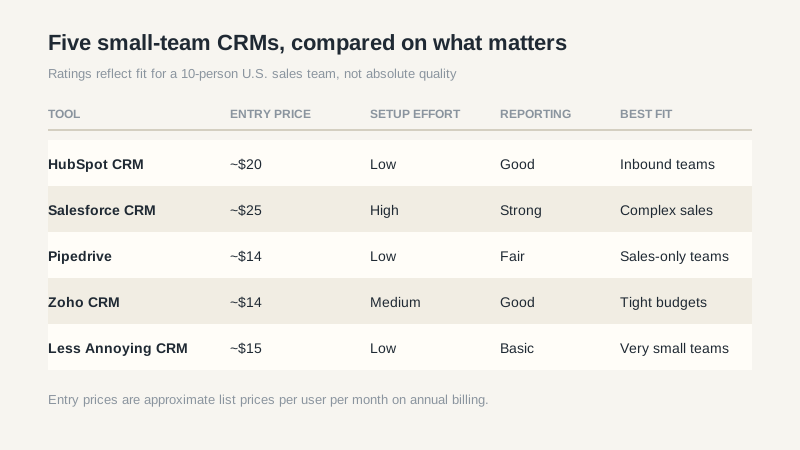
| Tool | Entry price | Setup effort | Reporting | Best fit |
|---|---|---|---|---|
| HubSpot CRM | around $20 | Low | Good | Inbound teams |
| Salesforce CRM | around $25 | High | Strong | Complex sales |
| Pipedrive | around $14 | Low | Fair | Sales-only teams |
| Zoho CRM | around $14 | Medium | Good | Tight budgets |
| Less Annoying CRM | around $15 | Low | Basic | Very small teams |
Prices are approximate list prices per user per month on annual billing. They move, and the tier you need will likely cost more than the entry price. Treat the table as a starting point for a quote, not a budget.
What Three Years Actually Costs
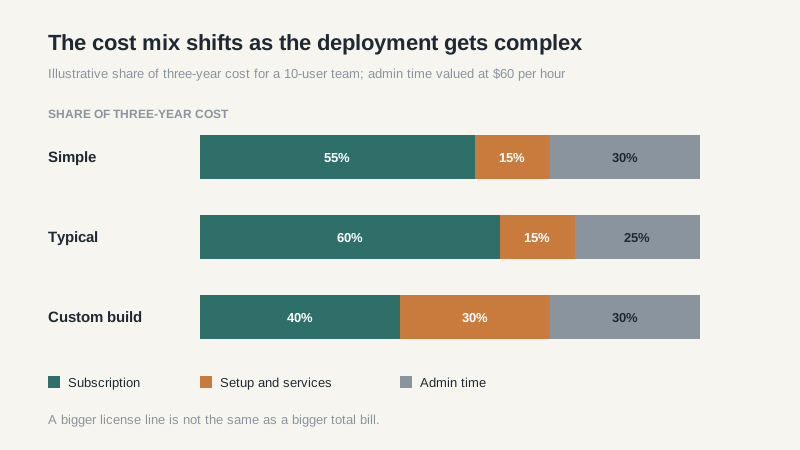
Take a ten-user team and do the arithmetic. HubSpot Starter lands near $2,400 a year before onboarding. Professional can land near $12,000 a year. Salesforce’s entry tier is roughly $3,000 a year for ten users, but implementation and administration push the three-year total well above the license line. Pipedrive and Zoho sit closer to $2,000 to $4,000 a year at that size, and Less Annoying CRM is a little under $2,000.
Those numbers are only the subscription. Add setup, data cleanup, and the hours someone spends managing fields and reports. In most small teams, that internal admin time is the largest hidden cost, and it’s the reason a $14 tool can cost more than a $100 tool if it needs constant repair.
What Each Tool Is Bad At
HubSpot CRM gets expensive fast, and the contact-based billing model punishes a messy list. The reporting you want for attribution often sits above the tier you budgeted for. Our HubSpot CRM review breaks down the tier cliff in detail.
Salesforce CRM demands an owner. Without one, the org becomes a museum of half-finished custom fields. The entry edition also runs out of room quickly, and the next tier is a real jump. Small teams often pay for flexibility they never use.
Pipedrive is excellent at pipeline mechanics and thin everywhere else. Marketing automation, complex reporting, and service workflows are limited or absent. If you need one system for the whole customer lifecycle, it will feel narrow.
Zoho CRM gives you a lot for the money, but the interface is denser and the ecosystem is sprawling. Support quality varies by plan and region, and the number of settings can overwhelm a team without an admin. It’s a good value if you’ll invest the setup time.
Less Annoying CRM is deliberately basic. Reporting is thin, automation is minimal, and integrations are limited. That’s fine for a five-person team that needs a shared list. It’s the wrong choice the moment you need routing rules or a real forecast.
My Default Recommendation
For most small U.S. teams selling to businesses, I’d start with Pipedrive if the job is purely pipeline management, or HubSpot Starter if marketing and sales need to share a contact record. Both are easy to adopt and easy to leave. If you have a genuinely complex process and someone who will own the system, Salesforce is worth the overhead. If the budget is the binding constraint, Zoho or Less Annoying CRM will do more than their prices suggest.
Then run a thirty-day pilot with two finalists and real leads. Not a sandbox tour. Import your actual list, build your actual stages, and see which tool your least technical rep opens without being reminded. That test tells you more than any comparison table, including this one.
Buy for the process you have, not the process in the demo. The best CRM software is the one that makes your current sales motion visible, and the one your team will still update in month seven.
