ELEADS CRM is one of those products a dealership doesn’t choose so much as inherit. A group buys it, the BDC team learns it, and the sales managers spend the next year figuring out which reports to trust. That’s not a knock on the software. It’s a description of how dealership tools get adopted, and it shapes what an honest review can tell you.
I’ve worked with dealership CRMs as a consultant and as the person cleaning up after a bad rollout. ELEADS is a serious product for a specific business. It is not a generic sales tool with a dealership label pasted on, and that distinction matters if you’re comparing it to HubSpot or Pipedrive on a feature checklist.
What ELEADS CRM Does
The core is lead and customer management for a dealership: internet leads, phone-ups, showroom traffic, follow-up tasks, and a customer record that ties a person to the vehicles they’ve bought, serviced, or inquired about. Around that core sit modules for business development center workflows, desking, equity mining, service-to-sales, and marketing campaigns.
That module set is the reason dealers buy it. A sales manager can see which internet leads were contacted, how fast, and by whom. A BDC director can build a call list from unsold showroom traffic. A desk manager can work a deal without retyping the customer’s information. In a store that uses those pieces, the system earns its keep. In a store that uses it as a Rolodex, it’s an expensive Rolodex.
The Dealer Workflow It Was Built Around
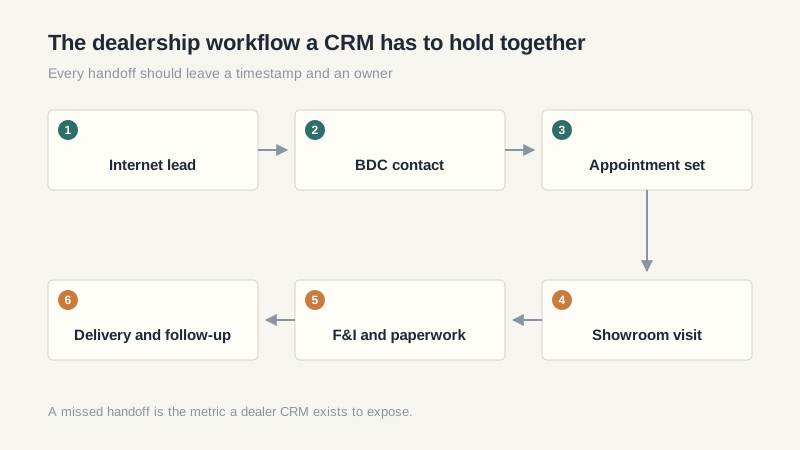
The workflow runs from lead to BDC contact to appointment to showroom visit to desk to finance and insurance to delivery and follow-up. Each handoff is supposed to leave a timestamp. That’s the real product. Dealers live and die on response time and follow-up cadence, and a CRM that records both gives a manager something to coach against.
Generic CRMs can be configured to mimic this sequence, but they don’t ship with the vocabulary. They don’t know what a “be-back” is, they don’t track equity mining, and they don’t connect a service visit to a trade-in conversation without custom work. If you’re a franchise dealer, that vocabulary saves months of configuration. If you’re a three-person independent lot, you’re paying for words you’ll never use.
Pricing and Contract Terms
ELEADS CRM doesn’t publish a standard price, which is common in dealership software. The quote depends on the number of users, the number of rooftops, and the modules you add. Expect the base CRM, desking, equity mining, and marketing tools to be priced separately, with onboarding and training as their own line items.
Ask for the all-in monthly number for year one and year two, including every module and every user. Ask whether the price is per rooftop or per store, because a group with four franchises can get surprised by how the count is defined. Ask about the auto-renewal window and the notice period. Dealership contracts often run twelve to thirty-six months, and the renewal clause is where your negotiating room disappears.
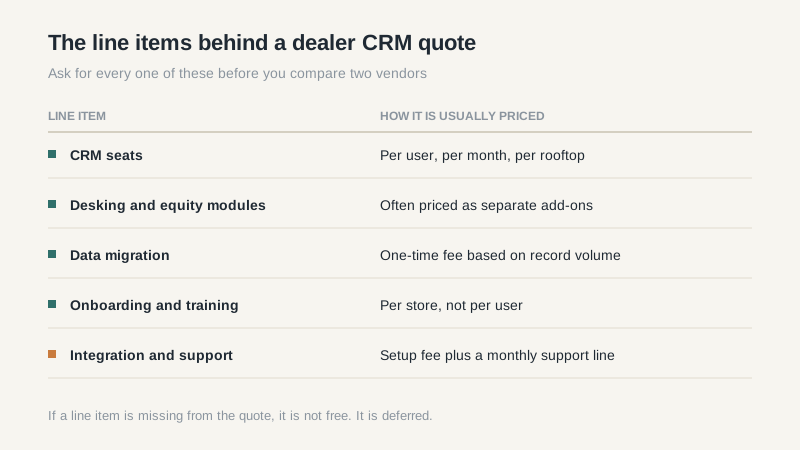
Training deserves its own budget line. The software is dense, and a two-hour walkthrough won’t get a BDC team fluent in the lead queues and the reporting. Plan for role-based training: sales reps, BDC agents, desk managers, and the person who owns the reports. That’s four different jobs, and one session for everyone shortchanges all four.
Where ELEADS CRM Gets Frustrating
The interface is built for depth, not speed. New users click through more screens than they expect, and the module sprawl means the thing you need is sometimes in a place you’d never look. Dealers who came from a simpler tool describe a month of feeling slow before the workflow clicks. Budget for that dip in productivity, especially if you’re switching during a busy sales month.
Reporting is powerful and requires training. The standard reports cover the metrics a dealership cares about, but building a custom view or interpreting the lead source data takes practice. If nobody owns reporting, the store ends up with a stack of printouts and a manager who still asks the BDC for a manual count.
The bigger issue is discipline. ELEADS CRM will not fix a store where nobody answers the phone, where leads sit in a queue until the end of the shift, or where managers don’t review follow-up. The software makes those failures visible. That’s useful, and it’s also uncomfortable. A CRM rollout is a management change project with a database attached.
Who Should Buy It
Franchise dealerships and used-car groups with a real BDC, multiple rooftops, and a manager who will own the system. It fits stores that want desking and equity mining in the same place as the lead record, and groups that need consistent reporting across locations. The value scales with the number of handoffs you’re trying to control.
It does not fit a small independent lot with three salespeople and no BDC. A generic CRM at $15 to $30 per user per month will handle the pipeline, and a spreadsheet will handle the follow-up list. Paying for dealership modules you won’t use is how small lots end up resentful of the software and the contract.
Alternatives Worth Pricing
If you’re a dealer, price the dealer-specific options alongside ELEADS: VinSolutions, DealerSocket, and CDK’s CRM are the names that come up most often in conversations. Each has a different strength, and the right one depends on your DMS and your group structure. Get two quotes with the same module list so you’re comparing the same scope.
For a smaller independent store, start with a general-purpose tool. Our best CRM software comparison covers the small-team options and what they cost. The customer relationship management guide is the better place to start if your problem is process rather than software.
Whatever you choose, ask for a thirty-day pilot on one rooftop with your own lead data. Not a demo with sample customers. One store, real leads, and a weekly review of response time and follow-up completion. If the vendor won’t agree to that, you’ve learned something more useful than any feature comparison.
