Halfway through a demo last spring, a sales director asked me whether “the CRM stock” was a healthy sign. She meant Salesforce, and she meant the ticker. It’s a fair instinct. If you’re going to put your pipeline and your reps’ daily habits inside a vendor’s product, you want to know the company will still be there in five years.
That’s where the NYSE CRM listing comes in. Salesforce, Inc. trades on the New York Stock Exchange under the symbol CRM. The ticker is short, memorable, and spells the category the company sells. It’s also attached to a public filing trail that any buyer can read before signing a contract.
What follows isn’t investment advice. It’s a buyer’s guide to reading a public software company the way a buyer should, not the way an analyst chasing a quarter does.
What a Stock Listing Actually Means for a Software Buyer
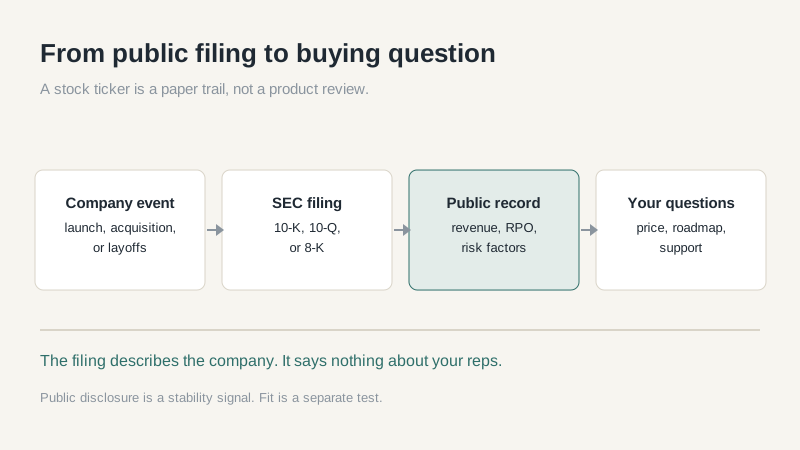
A stock listing means the company has shareholders, audited financial statements, and a legal obligation to disclose material events. It means quarterly earnings calls, an annual 10-K, quarterly 10-Qs, and 8-K filings when something big happens. For a buyer, that’s useful transparency. You can see revenue, margins, debt, and the risks the company admits in writing.
It does not mean the product fits your team. A public company can be profitable and still be a poor match for a twelve-person sales floor. Plenty of healthy vendors sell software that requires an admin your business doesn’t have.
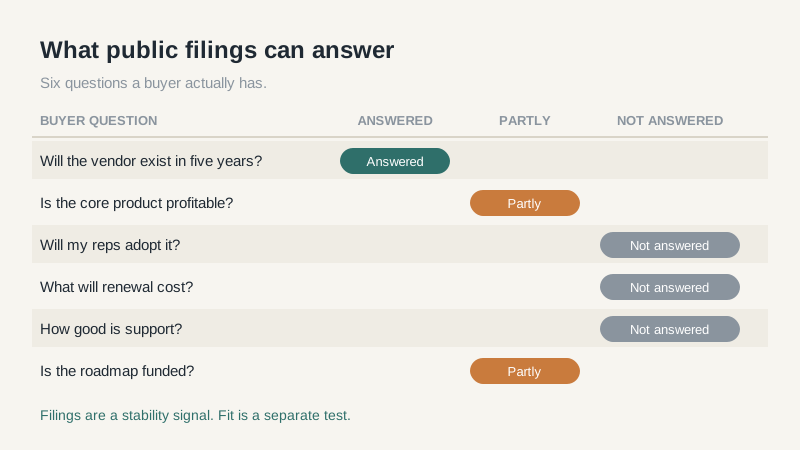
The listing is a stability signal, not a fit signal. Keep those separate in your evaluation or you’ll confuse a strong balance sheet with a strong implementation.
What the NYSE CRM Listing Actually Discloses
The 10-K is the most useful document for a buyer. It explains how the company makes money, which segments are growing, and where management sees risk. The risk factors section is the part most buyers skip. Read it. If a vendor names competition, pricing pressure, or execution risk on acquisitions, that’s the company telling you where the next two years will be hard.
Remaining performance obligation, usually shortened to RPO, is another line worth understanding. It represents contracted revenue not yet recognized. A rising RPO suggests customers are signing longer or larger deals. A flat RPO in a growing company can mean shorter contracts or more month-to-month business. Neither is automatically good for you, but both tell you how the vendor is pricing and what kind of renewal pressure is coming.
Stock-based compensation gets less attention from buyers than it should. Heavy equity comp in sales roles tends to produce aggressive quotas and quarter-end discounting. That can work in your favor if you negotiate late in a quarter, and against you if you sign a multi-year deal at list price in week two.
Which Numbers Matter to Your Negotiation
You don’t need a finance background to use a filing. You need four questions and a willingness to ask them plainly.
| Filing item | What it tells you | Ask the vendor |
|---|---|---|
| Revenue growth | Whether new customers or expansion drive the business | “How much of next year’s target depends on price increases?” |
| RPO | How much revenue is already locked in | “Is retention or new logo growth the priority this year?” |
| Risk factors | What the company admits could hurt it | “How does that risk show up in support and roadmap?” |
| Stock-based comp | Sales culture and quarter-end behavior | “What discount authority does my rep have?” |
None of those answers will come from a demo. They come from the person who owns the commercial relationship, and they’re fair to ask before you sign. A vendor that can’t answer them is telling you something too.
The Ticker Can’t Tell You Whether Your Reps Will Use It
Adoption is the number that decides whether a CRM earns its cost. Public filings won’t show you a twelve-person team that bought an enterprise edition and uses it as an expensive address book. That failure is common, and it doesn’t appear in an earnings report.
Ask instead about the work a rep does on a Tuesday afternoon. How many clicks to log a call? Can they see their own pipeline without building a report? Does the mobile app work when the signal is bad? What happens when someone changes a picklist value and every historical report shifts?
Data hygiene belongs in the same conversation. A CRM is only as good as the fields people actually fill in. If your team can’t agree on what counts as a qualified opportunity, the software will faithfully record the disagreement at scale.
Support deserves its own test. Ask how tickets are triaged, what response time is promised in the contract, and whether the person answering has ever configured the product. A public company can afford a large support organization and still route your case to a queue that never moves. During the trial, open two tickets with real questions and time the answers.
A Blunt Read for Small Sales Teams
If you run six or eight sellers, the ticker should sit near the bottom of your list. Your real questions are about administration, training, and exit. Who will own the system after launch? What does a new hire need to learn in week one? Can you export contacts, activities, notes, and attachments if you leave? What’s the renewal uplift clause?
Where the NYSE CRM listing does help is in the contract. A large public vendor usually has a standard data-export process, a security team that answers questionnaires, and a reputation it wants to protect. Those things matter when your pipeline is the asset. If you’re still narrowing the platform list, start with a practical Salesforce guide and a selection framework before you negotiate.
Before your next demo, pull the last two earnings calls and the risk factors section of the annual report. Write down one question from each. Then watch how the vendor answers. The quality of that answer will tell you more about the next five years than any feature slide.
