A job posting asks for “SFDC admin experience.” A partner sends a statement of work with “SFDC configuration” priced by the hour. A new sales ops hire asks whether SFDC is a different product from Salesforce. All three are talking about the same platform, and the confusion costs teams real money in scoping meetings.
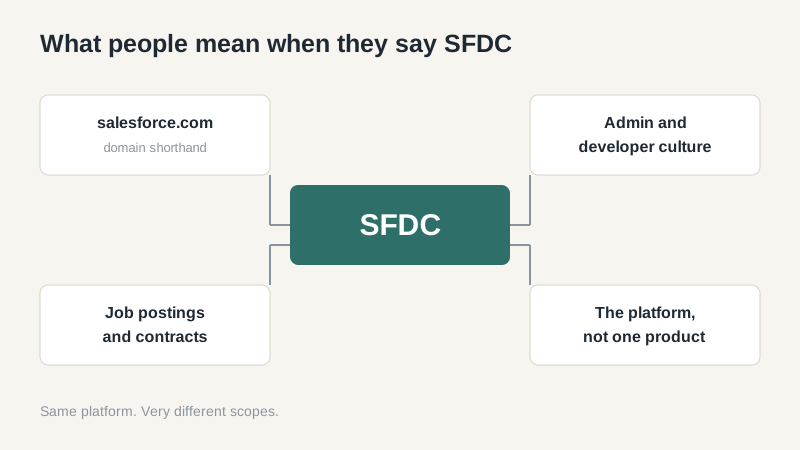
The phrase SFDC CRM shows up in job boards, contracts, and internal tickets because the people who work in the tool every day needed a short name for it. SFDC comes from salesforce.com, the company’s original domain and the name it used for years. It is not a product edition, a module, or a separate vendor.
Where the Abbreviation Comes From
Salesforce launched as a web-based sales tool and built its identity around the salesforce.com address. Practitioners shortened that to SFDC in the same way other industries shorten long company names. The abbreviation stuck in admin and developer circles, then spread into job listings and procurement documents.
One source of confusion: SFDC is not the stock ticker. Salesforce, Inc. trades under CRM on the New York Stock Exchange. If you see SFDC in a financial document, someone is using the old shorthand, not quoting a symbol.
SFDC CRM Is Not a Separate Product
When a contract says SFDC CRM, read it as “the Salesforce platform configured for sales.” The core objects are familiar to anyone who has worked in the tool: leads, accounts, contacts, opportunities, and activities. Sales Cloud is the bundle most teams mean, but the same platform also supports service, marketing, and custom applications.
That breadth is the reason the abbreviation is vague. A company can run sales in Salesforce and nothing else, or run sales, support, field service, and a customer portal on the same underlying system. Two people saying “we use SFDC” may be describing very different footprints.
For a buyer, the practical question isn’t what SFDC stands for. It’s which clouds, editions, and add-ons are in scope, and who administers them after the partner leaves.
What SFDC Signals in a Job Posting or Contract
SFDC experience on a resume can mean anything from building reports to writing custom code. The title usually narrows it down. An administrator handles users, permissions, fields, page layouts, and reports. A developer writes automation and integrations, often in Apex. An architect owns the data model and the long-term design. A consultant may do all three in a small engagement and none of them well.
Certifications help, but they don’t replace a work sample. Ask for a redacted example of a report, a validation rule, or an integration they built. Ask what they’d do differently. The answer separates people who have maintained a system from people who have only set one up.
In contracts, watch for scope language. “SFDC configuration” can cover a week of field changes or six months of custom development. Put deliverables and hours in writing, and name the environment where work will happen.
The Real Cost of an SFDC CRM Project
List prices for Salesforce editions run from roughly $25 per user per month at the entry level to more than $300 at the top, billed annually. Most small and mid-sized sales teams land in the middle. The license is rarely the biggest line item in year one.
Implementation is. A partner often charges somewhere between half and one and a half times the first-year license fee, depending on integrations and data quality. Internal time adds more: someone has to define stages, clean the account list, test the build, and train reps. Budget 10-15% of the first-year license for training alone, and assume an admin will need a quarter of a full-time role at minimum.
The costs that surprise people are the quiet ones. Extra sandboxes, add-on products for quoting or document generation, storage, and the consultant you call every time a field change breaks a report. Ask for a three-year view, not a first-year quote.
Where SFDC CRM Projects Go Wrong
The most common failure I see is a data model copied from a spreadsheet. Someone imports every column from the old tracker, adds a picklist for each, and creates a system that reps avoid because it asks for information nobody uses.
The second is automation sprawl. A handful of rules turn into dozens, each written by a different person, and no one can explain why an opportunity changed stages at 2 a.m. When something breaks, the fix takes a day and the audit trail is thin.
The third is reporting without an owner. Dashboards get built during implementation, then drift as stages and territories change. Six months later the forecast is wrong and everyone blames the tool. Usually the tool is doing exactly what it was told.
A Sensible First-Year Scope
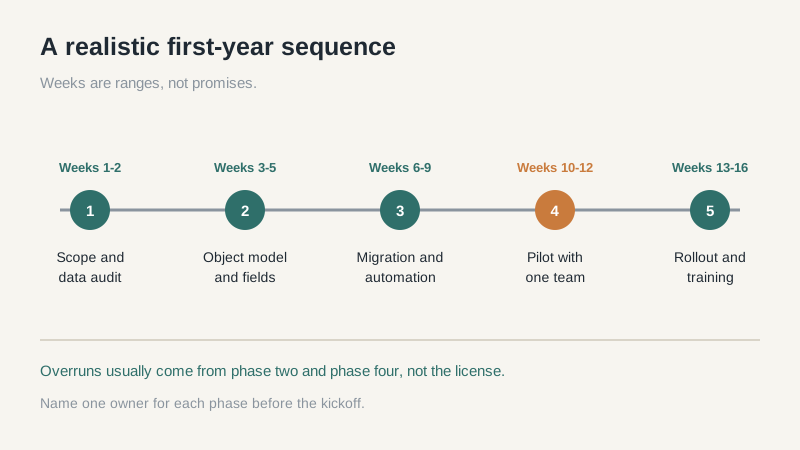
Start with the smallest edition that supports your required objects and permissions, not the one with the best demo. Keep the object model boring. Limit custom fields to the ones a rep can explain in one sentence, and make the required ones genuinely required for the next step in the deal.
Migrate a small, clean slice of data first. Run one team through a full month before opening it to everyone. Write down who owns administration, who owns reporting, and who approves changes. Those three names matter more than the feature list.
Measure adoption in the first month, not at the end of the quarter. Count how many opportunities have a next step, how many calls are logged, and how many deals moved backward. Those numbers tell you whether the build matches the work. If reps are keeping a spreadsheet on the side, the data model is asking for too much.
If you have fewer than ten reps and no admin, don’t buy the top edition because a partner told you it’s the only serious option. A smaller edition, a clean data model, and two days of training will beat an enterprise build nobody maintains. Read a practical Salesforce guide before you scope, and keep the public filing trail in mind when you negotiate a multi-year term.
